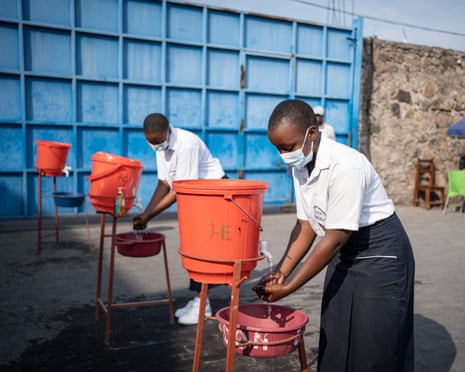

To be around the centre of an Ebola outbreak is to become used to the smell of chlorine. At hospitals and government buildings, surfaces are sprayed with it and hands washed in a 0.05% solution that can kill the virus in 60 seconds.
Infrared handheld thermometers take temperatures at airports and border crossings. Any indication of a fever prevents passage. Contact-tracing teams crisscross the countryside.
From 2018 to 2020, Butembo, in the Democratic Republic of the Congo’s northern Kivu province, was the setting for the largest Ebola outbreak the country had seen. The complexities of the crisis were not confined to the ravages of the virus itself – they were intensified by social, political and economic pressures of an area in the midst of a conflict.
As global health officials wrestle with a serious new Ebola outbreak in the DRC, which has shocked the World Health Organization with its speed and scale, the question is what lessons have been learned from previous outbreaks?
Ebola, unlike Covid, is not a particularly efficient virus. As it is not airborne it requires physical contact with bodily fluids, including blood and vomit, to spread. That makes it particularly risky for healthcare workers, who need full-body personal protective equipment (PPE) and stringent disinfection processes.
Social practices including physical contact with the dead and dying in poor rural communities accelerated the spread in eastern Kivu and Ituri province.