An election that could shape the future of UK politics for years to come is taking place on Thursday. But it is only happening in one small part of north-west England, with little more than 70,000 people eligible to vote.
Why? It is a question with a number of answers, some connected to the structure of the British political system, others much more topical.
In brief – what’s happening and why does it matter?
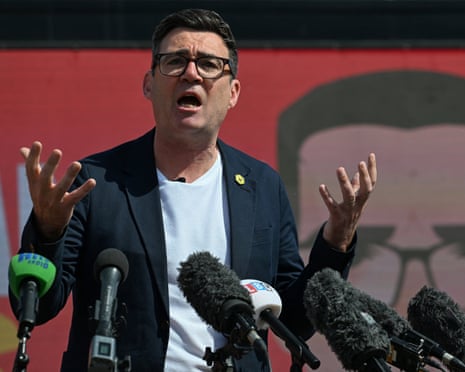
Voters in Makerfield, a largely suburban constituency on the edge of Wigan, Greater Manchester, are choosing a new MP after the incumbent stood down. The candidate for the ruling Labour party and favourite to win, Andy Burnham, is the mayor of Greater Manchester and a former MP.
If Burnham wins, it is widely assumed that he will launch a campaign to unseat Keir Starmer as Labour leader and thus UK prime minister, or persuade Starmer to stand down. If things go as expected, the UK could have its seventh prime minister since 2017 in just a few weeks or months.
How does all this work constitutionally?
The prime minister is, under very strong constitutional convention – there is no written constitution in the UK – always a member of the House of Commons, all 650 of whom represent a specific geographical constituency.
Burnham was from 1997 to 2017 MP for the adjoining seat of Leigh, serving as a government minister and twice standing unsuccessfully for the Labour leadership. But he left Westminster when Labour was in opposition after being elected Greater Manchester mayor.
For him to challenge Starmer, Burnham needs a new seat. After much wrangling one of his allies, Josh Simons, agreed to stand down as the Makerfield MP, triggering what is known as a byelection, a single-seat contest held when there is a vacancy between general elections.
Why does Burnham want Starmer to go?
It’s not just him. About 100 Labour MPs have publicly called on Starmer to quit, with many others privately sharing the sentiment. A lot of it is self-interest – Labour is consistently polling well behind the hard-right populist party Reform UK, and performed terribly in May in elections for the devolved Scottish and Welsh parliaments and local government seats across England.
But many Labour MPs also think Starmer lacks any political vision or much of a plan, and have seen him lurch from U-turn to U-turn. A number are worried that without action, Reform will win the next election.
Will Burnham win the seat?
The short answer is that, yes, most people believe he will, even if it could be a fairly close result. The longer answer is that Makerfield is the sort of seat Labour used to win with ease – the party has held the constituency since it was created in a 1983 reorganisation of parliamentary boundaries – but now struggles with.
With its voters disproportionately being older, less well educated and less likely to come from minority ethnic backgrounds, Makerfield, like dozens of similar post-industrial seats in the north of England, now heavily favours Reform, led by Nigel Farage, the driving force for the UK’s decision in 2016 to leave the EU.