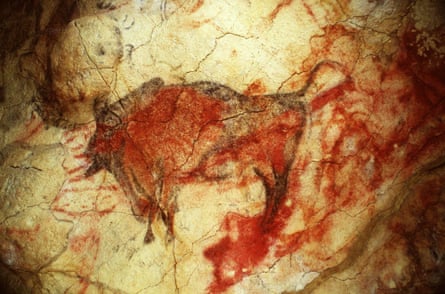
The aurochs, the mammoth and the steppe bison are long extinct, but their painted likenesses still look relatively fresh across the walls and roofs of Altamira. Or so said Diego Garate Maidagan, one of the very few humans allowed to enter that exalted cave in northern Spain.
I met Garate last summer in a small Basque village called Gautegiz Arteaga. A professor of prehistory and Palaeolithic art at the University of Cantabria, he told me he had been inside Altamira as recently as the week before, furthering his lifelong investigations of the prep work, tools and methodologies developed by early Homo sapiens painters.
About 34,000 years ago, our distant ancestors began making frescoes with chiaroscuro effects through that suite of subterranean vaults, which remained in use for many millennia, until the cave mouth was sealed by a rockfall. The best part of a geological epoch passed before a curious gun dog clawed its way across the threshold in 1868, leading a succession of witnesses into the first such prehistoric gallery ever seen by modern eyes.
The technique on display at Altamira seemed much too sophisticated for troglodytic numbskulls, as Palaeolithic people were then assumed to be, and self-appointed experts from France initially declared the whole thing a hoax. (Those accusers were to look pretty stupid when similar caves were found in their own country.) Pablo Picasso is said to have visited, or at least looked at some photos, and the quote attributed to him is possibly apocryphal, but an appraisal for the ages nonetheless: “After Altamira, all is decadence.”
The site was opened to the public in 1917, partly closed in the 1970s, then shut for good in 2002, as a century or so of gaping admiration revealed the paint-stripping effects of moisture and carbon monoxide from the breath of too many beholders. A replica cave, with replica artwork, was created on an adjacent site. Today, only Garate and other select scholars have access to the original sanctuary.
Garate’s specialism requires close attention to the etching or “pecking” technique whereby the artists used flint blades to outline figures on the rock before applying their ochre and charcoal. Altamira is rare and precious, he told me, because those reds and blacks are still so solid and vivid. The colours were preserved in the near-quarantine conditions imposed by that long-ago landslide.
The latest thinking on the subject proposes that our ancestors painted their way across western Europe, and what we now know as “cave art” is only what survived on the deepest, darkest surfaces they touched.
Luck, and geology, left us a few great sanctuaries on the scale of Altamira, and a preponderance of others where the pigments are long gone from the walls – eaten by creeping bacteria, effaced by sheets of calcite, scoured away by air and water. All that remains in most cases are vestigial chisel marks, tracing the legs and horns and tusks of beasts that were once as common as cattle. Like the “shadow pictures” sometimes detected by X-rays beneath the weave of canvases by Titian or Caravaggio, these proto-images are very hard to see without expert intervention.
In the far north of the Basque Country, the recent search for such apparitions has stirred “a little revolution”, by Garate’s reckoning. He should know, being the main instigator. He is also a native, and lives with his wife and kids in the same small estuary town, Plentzia, where he grew up.
The day we met, Garate presented as adventure-ready: face stubbled, hair short enough for the army, a wiry, handsome guy in very good shape for early middle age, wearing tactical trousers with padded knees. He picked me up in a messy hatchback that doubled as a locker for his caving gear, and we drove over the kind of mountain road that can quickly make a note-taking passenger carsick.
Garate and his colleagues in Santander planned a campaign to test a working theory: that the caves of northern Spain and south-western France were once lavishly decorated with pictograms and petroglyphs, now barely visible to the untrained eye.