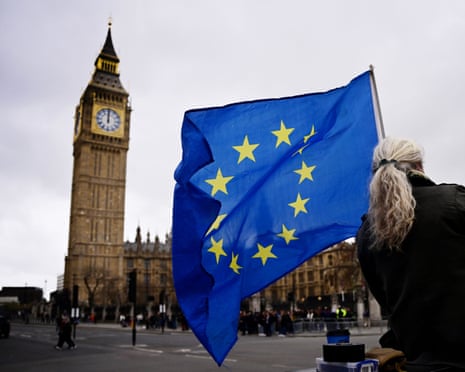
Wes Streeting, who resigned as Britain’s health secretary last week and has said he will run in any contest to replace Keir Starmer as the Labour leader and prime minister, has described Brexit as a “catastrophic mistake” and said the UK should rejoin the EU.
Andy Burnham, the Labour mayor of Greater Manchester, who will fight an upcoming byelection on a promise to challenge Starmer, has also said he saw a “long-term case” for rejoining – although he would not be advocating it immediately.
The comments by two of the key figures manoeuvring to be Britain’s next prime minister have thrust the UK-EU relationship back into the centre of political debate. Here’s a look at where that relationship stands – and how a bid to rejoin could be received.
What is the state of the UK’s relationship with the EU?
Soon after he was elected in 2024, Starmer promised a “reset” of the UK’s ties with the rest of Europe, hoping to draw a line under years of fractious relations with the 27-member bloc and secure a range of new economic and other deals with Britain’s largest trading partner.
A year later, the prime minister said a wide-ranging agreement signed at a feelgood UK-EU summit in London “gives us unprecedented access to the EU market, the best of any country”, and would deliver “cheaper food and energy” for British people.
After Labour’s local election drubbing this month, Starmer again promised his government would be “defined by rebuilding our relationship with Europe, by putting Britain at the heart of Europe”. But concrete progress so far has been at best limited.
The UK has rejoined the EU’s Horizon science programme – although that was agreed under the previous government – and will rejoin the Erasmus+ programme for educational and training exchanges from 2027, at least for a year.
But in other areas, talks are tricky. Negotiations over a “youth mobility scheme” to allow young Britons to live and work in EU countries and young EU citizens to live and work in the UK for a period are bogged down over the issue of tuition fees for EU students.
UK integration into Europe’s electricity market has been held up by London’s refusal to pay into EU “cohesion funds” in exchange, while a deal to allow the UK to join the SAFE defence procurement fund also fell through over the financial contribution demanded by Brussels.