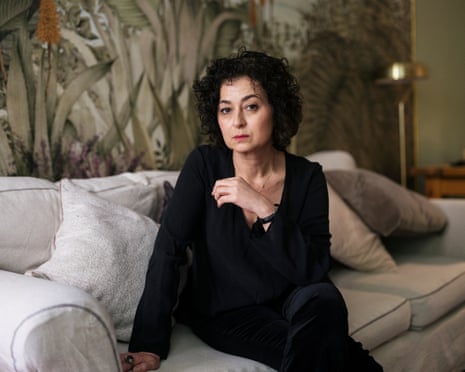
One summer’s evening in 2022, the Turkish writer Ece Temelkuran found herself in a doctor’s office in Hamburg, Germany, lying flat on a stretcher with an IV drip in her arm. After six intense years of work and travel, her body was in revolt. “I now know that I need to talk,” she writes in her latest book, Nation of Strangers, which was shortlisted for the 2026 Women’s prize for nonfiction. “I fear that not speaking will make me really sick. And when homeless, you cannot afford to get sick.”
In fact, she had not been silent in the preceding years: she had published two well-received books, How To Lose a Country: The Seven Steps from Democracy to Fascism (2019) and Together: A Manifesto Against a Heartless World (2021). She had spoken her warnings in public, too, on stages all across the west, saying: this is what happened to us in Turkey – make sure it doesn’t happen to you, too. And she is not technically homeless; she lives in Berlin. But by “speaking” and by “home”, Temelkuran means something specific yet vast. Nation of Strangers posits that the idea of home, and the emotions that idea contains, is one of the dominant political forces of our time.
Temelkuran became a journalist at 19, while still in the thick of a law degree; she was a senior reporter for CNN Türk and then a political columnist critical of Recep Tayyip Erdoğan’s government. She has also published several novels and prose poems. For years, she operated successfully in the bruising milieu of male-dominated newsrooms, in a patriarchal, increasingly nationalistic culture. But as Erdoğan tightened his grip, life became increasingly difficult: death threats, rape threats, emails “reporting [my] life minute by minute”, to show her that she was being closely watched.
She and her colleagues coped by laughing it off. “And then our friend Hrant Dink was killed [by a Turkish nationalist on 19 January 2007]. One day before that, we were joking – you know, comparing our death threats.”
Her books began to be used as evidence in people’s arrests; soon after, six or seven columns were published calling for her own detention. Then, one night, she woke to find that the iron bars on her windows had been removed and a window left open. Nothing was taken, but, she writes, “I took it as a message saying: ‘We could do it.’” On 6 November 2016, she called her mother from Zagreb, Croatia, to tell her she wasn’t coming back: “A one-minute phone call; half of it was silence. But that’s all it took for me, in the autumn of 2016, to become homeless.” She was 43.