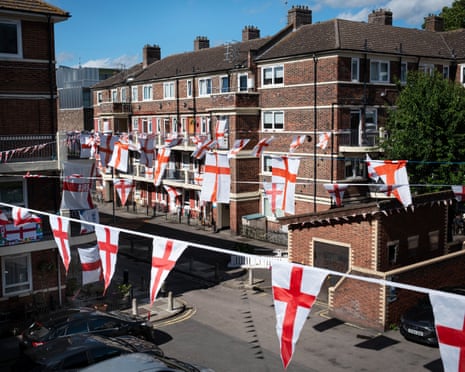

As I drove into London with my daughter a week ago, we passed a roadside pub festooned with dozens of England flags. Our eyes met in recognition: we were in one of those areas, we assumed. In the eyes of many, St George’s cross flags have become a kind of territorial marker in the English landscape, signifying a certain kind of identity, a certain kind of politics, not necessarily welcoming to all. As we got closer, though, we realised the pub was actually preparing for the start of the World Cup. Flags of other nations were also on display. We laughed at our mistake and relaxed a bit.
It’s a feeling many Britons might have experienced. We’re gearing up for a summer of both exciting international football and ugly far-right protests and riots, as recent events in Belfast and Southampton have shown. The England flag will be a prominent fixture of both – great news for flag sellers, but a confusing and anxious time for the rest of us. How did England’s national symbol come to evoke such mixed feelings and carry such contradictory meanings? Are we really at the stage of “good flags” and “bad flags”? What are we supposed to think when we see an England flag?
Our politicians have been as uncertain about this as everyone else. That became clear last summer, when England flags and union jacks suddenly began to appear on lamp-posts in towns and cities across the country. St George’s crosses were painted on roads, roundabouts and elsewhere, sometimes accompanied by offensive graffiti. The initiative was pushed by groups such as Raise the Colours, a self-described “grassroots movement” that proclaimed it was campaigning “to cover Britain in symbols of unity and patriotism” – but it clearly generated local support too.